Operations & Brand Guide | By Yesiwell Product & Sales Team | April 2026
In twelve years of working with medical device distributors, the single most consistent source of preventable margin loss we see is not product quality, not pricing, and not logistics. It is packaging — specifically, packaging decisions made too quickly, too cheaply, or without thinking through what the end customer actually does with the box once they pick it up off a shelf.
The conversation about packaging usually happens in one of two ways. Either a distributor calls to ask what customisation options are available before they place a first order — which is the right time to have the conversation — or they call six months into a product launch because their return rate is higher than expected and they cannot figure out why.
In the second scenario, the product is usually fine. We have pulled returned devices, tested them, and found them performing within spec. The issue is almost always downstream: a customer who could not figure out how to use the device correctly, formed the conclusion that it was broken, and sent it back. That is a packaging and IFU failure. The manufacturer made a good device. The packaging did not do its job.
This matters more in medical devices than in almost any other consumer product category, for a simple reason: the people buying blood pressure monitors, glucose meters, and thermometers are frequently managing a health condition they are anxious about. They are not casual buyers willing to tolerate ambiguity. If the instructions are unclear, if the expected reading range is not explained, if the setup steps require inference — they do not figure it out. They call customer service, or they return the product, or both.
It helps to be explicit about what packaging actually needs to accomplish, because most generic manufacturer packaging is designed to accomplish only one of these four things.
1. Sell the device off the shelf. In a pharmacy or medical retail context, a customer selects a device — a blood pressure monitor, say — from a shelf where three or four competitors are sitting at similar price points. The packaging is doing the selling. There is no sales assistant, no demo, no conversation. The box has approximately four seconds to communicate that this product is worth picking up and reading more carefully. That means the front panel needs to convey one clear value proposition — accuracy, ease of use, clinically validated, whatever it is — in language a non-clinical buyer can absorb instantly. Most generic boxes fail this test.
2. Confirm the purchase decision at the point of reading. Once the customer picks it up and reads the side panels, the packaging needs to reinforce that they made a good choice. This is where key features, certifications, memory capacity, cuff size range, and compatibility information belong. It is also where clinical validation claims, if you have them, do their heaviest lifting — a buyer standing in a pharmacy is more likely to believe a CE marking and a clinical reference than a marketing claim alone.
3. Prevent incorrect use. This is the function that gets ignored most often, and it is the most directly tied to your return rate. If a customer opens the box, reads the IFU, and still cannot figure out how to apply the cuff correctly — or does not understand why their reading differs from what they expected — the device comes back. Setup illustrations, measurement-site diagrams, and explicit callouts of what a normal reading looks like are not optional extras. They are the difference between a satisfied customer and a return.
4. Satisfy regulatory requirements. In Europe, a medical device's Instructions for Use must appear in every official language of the country where it is sold. A blood pressure monitor sold in Belgium requires French, Dutch, and German. Sold in Switzerland: French, German, Italian. A device that reaches a retailer's shelf without compliant IFU is not legally marketable — and if a market surveillance authority finds it, the importer (typically your entity, as the distributor) is liable, not the Chinese manufacturer. This is not a theoretical risk. It happens.
Most factory-default packaging from Chinese medical device manufacturers is designed for one purpose: passing inspection and getting the device into a box. It is not designed with your customer in mind, your market's language requirements, or your brand's positioning.
The specific gaps we see most often:
English-only IFU. Usable for markets where English is the consumer language. Legally non-compliant in most of Continental Europe, parts of the Middle East where Arabic is mandated, and increasingly in Southeast Asian markets with local-language requirements. Distributors who discover this after a container has cleared customs are in an expensive position.
Cuff size not stated on the outer box. For blood pressure monitors, this is the single biggest driver of returns after incorrect use. A customer with a large arm buys a standard cuff monitor, gets irregular readings because the cuff does not fit properly, and returns it. If the box had stated the applicable arm circumference range on the front panel, that customer would either have selected the right product or not purchased it — either outcome is better than a return.
No expected reading range guidance. Non-contact thermometers, glucose meters calibrated to plasma rather than whole blood, and wrist blood pressure monitors all produce readings that differ from what a patient may expect based on previous experience with a different device type. Without an explanation of normal inter-method variation, customers assume the device is inaccurate. A single sentence on the inside flap — "Forehead readings typically measure 0.3–0.5°C lower than oral measurements" — eliminates a significant share of returns for this reason.
Clinical claims without substantiation. A box that states "medical grade accuracy" or "clinical precision" without referencing the specific standard (ISO 81060-2 for blood pressure, ISO 15197 for glucose meters) is making a claim that cannot be verified by the buyer and may attract regulatory scrutiny. Worse, if the device does not actually meet those standards, you have an advertising compliance problem layered on top of a quality problem.
Packaging that cannot survive the retail environment. A box that arrives from the factory looking clean but dents, corners crush, or colour fades on a lit pharmacy shelf within two months is a problem that compounds across your entire inventory. The device inside may be perfectly functional. The presentation communicates something different.
| Product | Front Panel Must-Haves | IFU Critical Content | Common Omission That Causes Returns |
|---|---|---|---|
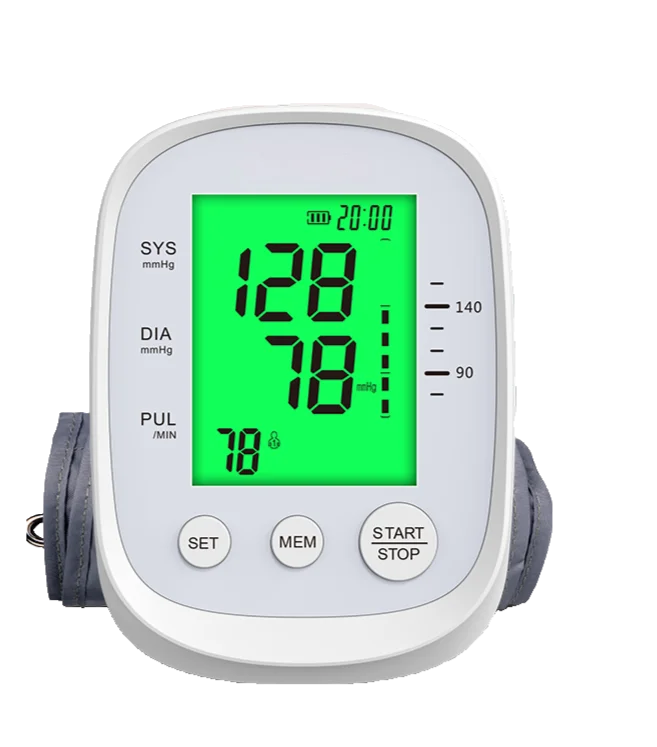
| Blood Pressure Monitor (Arm) | Cuff size range, memory capacity, IHB detection if applicable | Correct arm positioning diagram, reading interpretation table (normal/elevated/high) | Arm circumference range not shown; customers with large arms buy standard cuff |
| Blood Pressure Monitor (Wrist) | Wrist positioning at heart level — illustrated, not described | Step-by-step positioning with graphic, note on readings taken in wrong position | No positioning diagram; customer takes reading with wrist hanging; gets inconsistent numbers |
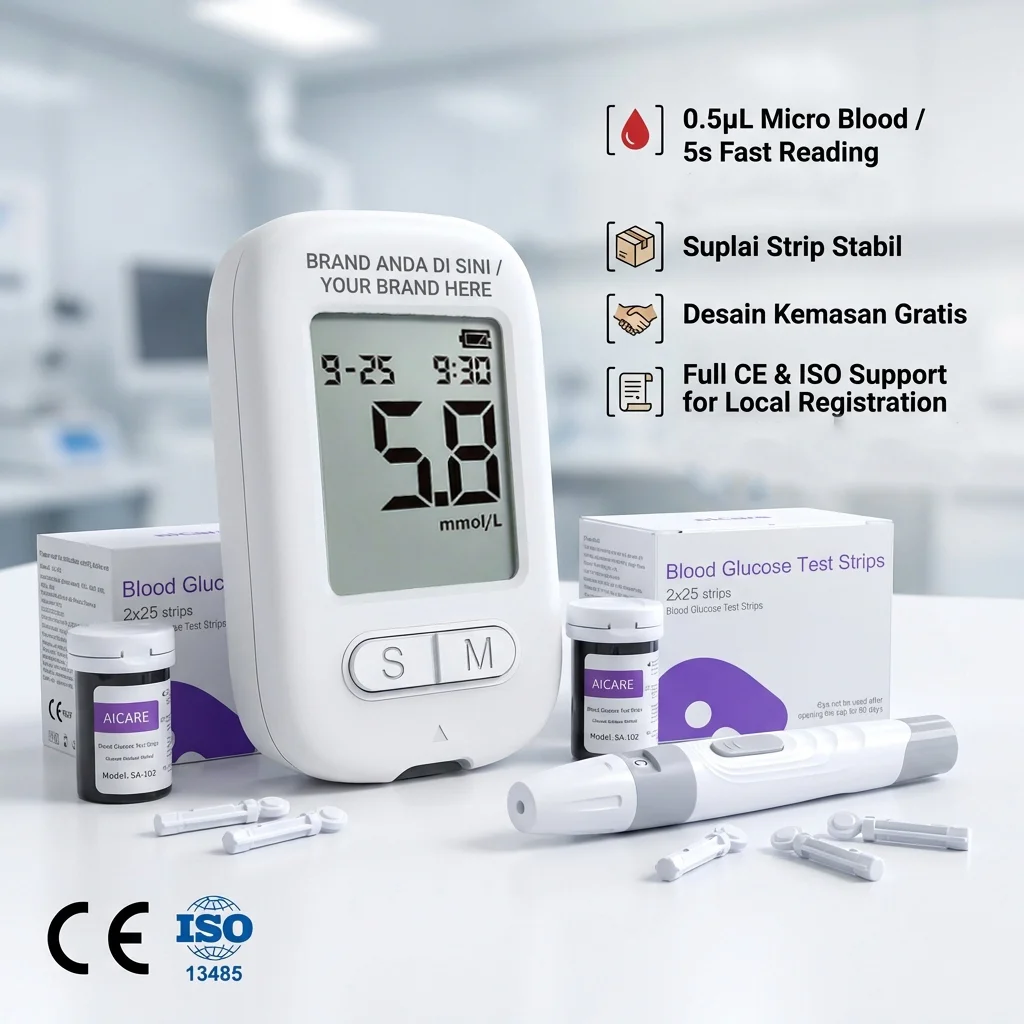
| Blood Glucose Meter | Plasma-equivalent calibration stated, strip compatibility clearly named | Lancet depth settings for different skin types, strip insertion direction | Strip brand not stated; customer buys incompatible strips from pharmacy and blames the meter |
| Non-Contact Thermometer | Measurement distance range (e.g. 3–5 cm), temperature unit (°C/°F switchable) | Reading offset vs oral measurement stated explicitly with a number | No offset guidance; customer compares reading to old oral thermometer and returns the device |
| Nebulizer | Medication cup capacity, mask sizes included, noise level if low | Assembly sequence with numbered diagrams, cleaning frequency, mask fit by age | Assembly steps unclear; customer cannot get the mask to seal; concludes device is defective |
Under the EU Medical Device Regulation (MDR 2017/745), the legal entity responsible for ensuring a device on the European market has compliant labelling and IFU is the importer — the company based in the EU that brought the product into the market. In most distribution arrangements, that is you, not your Chinese supplier.
This matters because the manufacturer's CE certificate covers the device itself. It does not automatically cover localised packaging produced by a third party, IFU translations that have not been reviewed against the original, or claims added to packaging during the localisation process that were not part of the original approved labelling. Each of those elements creates a separate liability point.
The practical implication is straightforward: any translation or modification to packaging and IFU should be reviewed against the original approved document, and the distributor should retain a copy of both the original and the modified version along with any translation certification. Most market surveillance actions in this area are triggered by complaints, not proactive inspection — which means the risk is real but often invisible until something goes wrong.
“We spent three months reworking our blood pressure monitor packaging before the German launch. Added the cuff size chart to the front panel, localised the IFU properly, put the reading interpretation table on the inside lid. Return rate in Germany was a third of what we'd seen in our first market. Same device. Different box.”
— EMEA distribution partner, Yesiwell
Can you provide the original approved IFU in English, so we can commission a compliant translation? Some manufacturers produce only a Chinese master IFU and provide a rough English translation alongside it. If the English version has not been reviewed against the approved Chinese document, translation errors compound silently.
What is the lead time for a packaging change, and what files will you provide? A good OEM supplier provides editable print-ready artwork files (AI or PDF), not just a photo of the box. If they can only supply a JPEG, your packaging agency will be working from scratch.
Does the CE certificate cover the device as it will be sold — including any bundled accessories? A monitor sold with a large cuff that was not part of the original CE testing may require updated conformity documentation.
What is the minimum order quantity for a custom packaging run, and is it the same as the device MOQ? These are sometimes decoupled, which can create an inventory mismatch on your first order.
Have other distributors used the same base device under different packaging in our target market? If yes, you are not the first to localise this product for that market, and you can ask to review how their packaging handled the local requirements.
What happens if packaging artwork is approved and then a product specification changes mid-run? Components change — display layouts shift, battery compartments move. Knowing the process for managing those changes before they happen saves a difficult conversation later.
Our OEM/ODM program includes full packaging customisation — editable artwork files, IFU localisation support, and guidance on regulatory labelling requirements for your target markets. We work with distributors across Europe and the Middle East who are building private-label ranges across our blood pressure monitors, blood glucose meters, thermometers, and other product lines.
If you are at the point of planning a first private-label order, the packaging conversation is the right one to have first — not last.
Speak to our team about packaging and IFU requirements for your market.
DISCUSS PACKAGING & OEM OPTIONS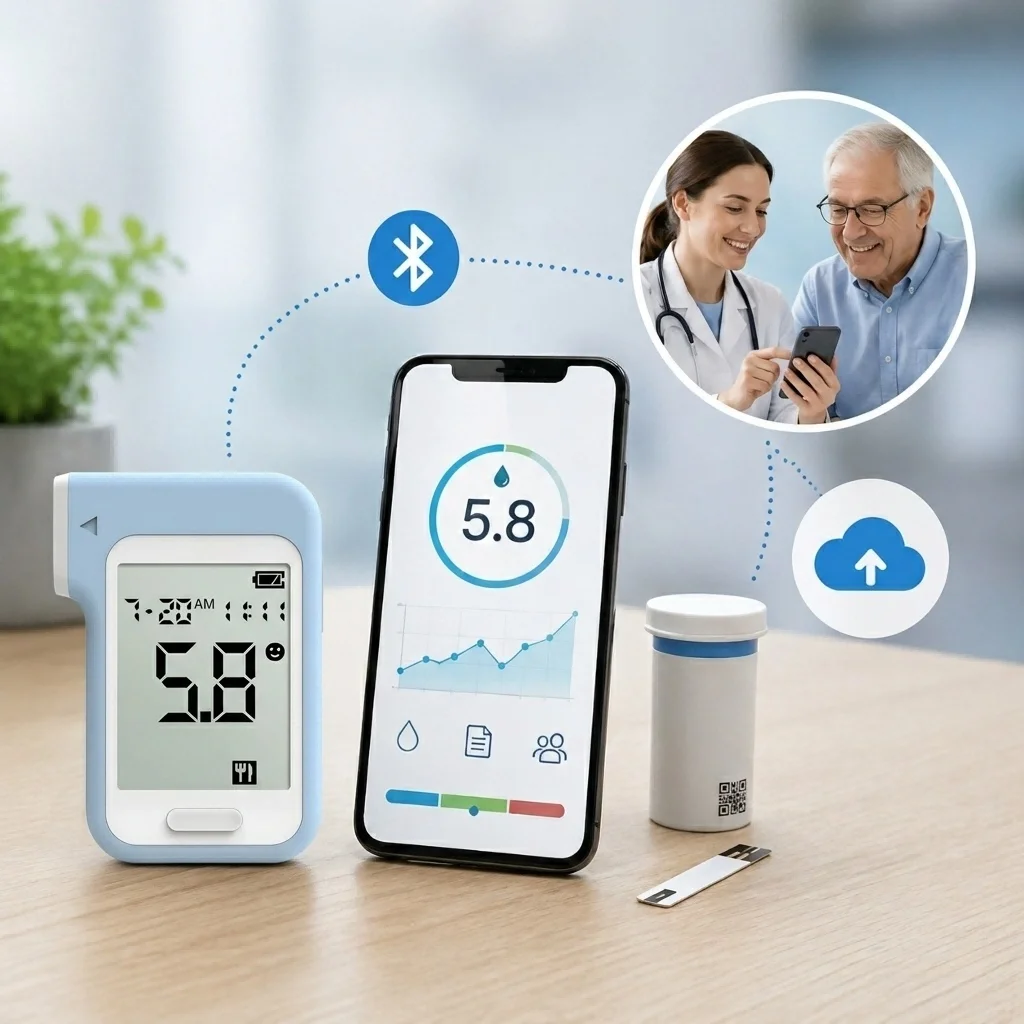
Connected glucose meters carry a higher price and more complex support requirements. Yesiwell's B2B guide helps distributors decide when the smart category is worth adding.
READ MORE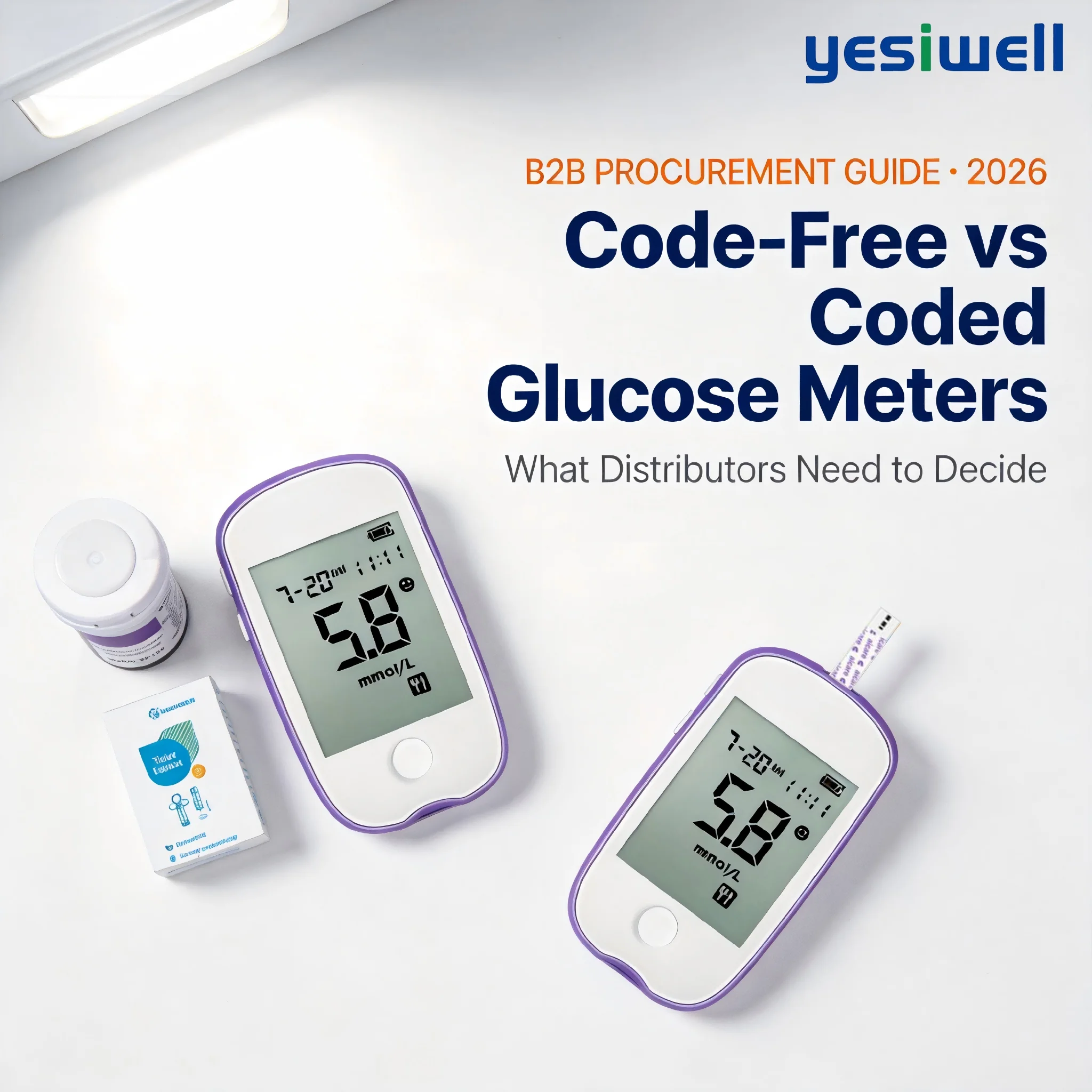
Most distributors default to code-free without asking why. The choice has real implications for your market, your margins, and how often customers call your support line.
READ MOREIf you are interested in our products, you can choose to leave your information here, and we will be in touch with you shortly.