B2B Procurement Guide | By Yesiwell Product & Sales Team | April 2026
When distributors place their first blood glucose meter order, the question of coded versus code-free rarely comes up. Most suppliers default to code-free, most buyers accept it without asking, and the decision gets made by inertia rather than by deliberate choice. That is usually fine — but not always. There are markets, customer profiles, and product configurations where the coded format is the better commercial decision, and distributors who understand the difference are better positioned to serve both.
Every batch of blood glucose test strips is manufactured with a slightly different enzyme concentration. The variation is small but real — enough to affect readings by a few percentage points if the meter does not account for it. The calibration code is how the meter compensates for this batch-to-batch variation.
In a coded system, each vial of strips carries a number — typically printed on the vial label or on a chip supplied with the vial. The user must enter this code into the meter before testing. If the code on the meter does not match the code on the current strip batch, the meter either refuses to work or produces readings calibrated to the wrong batch. A user who forgets to update the code when opening a new vial is measuring against the wrong baseline, and they will not know it.
In a code-free system (also called no-code or auto-calibrating), the calibration information is embedded directly into each individual strip — either in the strip chemistry itself or in a chip built into the strip. The meter reads the calibration data automatically at the moment of testing. The user does nothing extra. There is no code to enter, no vial label to check, and no risk of a mismatch between the meter's stored code and the current strip batch.
The shift toward code-free systems accelerated in the early 2010s, driven by a simple clinical observation: coding errors were a measurable source of inaccurate readings in real-world home use. Studies across multiple markets found that a meaningful proportion of patients — particularly elderly users and those managing multiple chronic conditions — either did not understand the coding requirement or simply forgot to update the code when starting a new strip vial.
The consequences range from mildly misleading readings to clinically significant ones. A patient consistently measuring against the wrong calibration code could be making insulin dosing decisions based on numbers that are off by more than the ISO 15197 accuracy margin allows. That is a patient safety concern, and regulatory guidance in several markets has since nudged manufacturers toward code-free designs as the lower-risk option.
For distributors, there is also a practical support argument. A customer who enters the wrong code and gets inconsistent readings will call your customer service line, not the manufacturer's. Code-free systems eliminate that call entirely.
Code-free is the right default for most markets. But there are specific contexts where a coded system is commercially defensible or even preferable, and dismissing it entirely means missing those situations.
Clinical and institutional procurement is the clearest case. In hospital outpatient settings, clinical pharmacies, and diabetes clinics, the end users are healthcare professionals or trained patients under clinical supervision. Coding errors in this environment are rare because staff follow protocols. At the same time, coded strips can carry a lower unit cost at volume — the absence of the embedded calibration chip means slightly lower per-strip manufacturing cost, and at the scale a clinic or pharmacy purchases, that difference accumulates.
Price-sensitive consumer markets are a second consideration. In markets where buyers are highly cost-conscious and the purchasing decision is made primarily on strip price, a coded system that offers a lower cost-per-test can outperform a code-free alternative — provided the distributor invests in adequate patient education at the point of sale. This is a more demanding distribution model, but it is not an unreasonable one in markets with strong pharmacy counselling infrastructure.
OEM and private-label programs sometimes favour coded systems for differentiation reasons. A brand that wants to ensure customers use only their branded strips — and not compatible third-party strips — benefits from a proprietary coding system that creates a degree of strip lock-in. This is a business model consideration rather than a clinical one, but it is a legitimate factor in how some distributors build their product ecosystem.
| Factor | Code-Free System | Coded System |
|---|---|---|
| User error risk | Minimal — no user action required | Moderate — coding errors do occur in home use |
| Customer support burden | Lower — fewer coding-related complaints | Higher — mismatch calls are predictable |
| Strip unit cost (B2B) | Slightly higher (calibration chip embedded) | Slightly lower at volume |
| Best end-user profile | Elderly, self-managing patients, first-time users | Clinical staff, trained patients, high-volume users |
| Regulatory direction | Favoured by EU and US guidance | Compliant but less favoured in new product guidance |
| Return rate driver | Low — fewer user-caused inaccuracies | Higher if patient education at POS is inadequate |
| OEM strip lock-in potential | Lower (open strip compatibility possible) | Higher (proprietary code creates ecosystem) |
| Market fit | Home use, pharmacy retail, elderly care | Clinical supply, institutional procurement, price-led markets |
Most distributors who think carefully about this end up stocking both formats — not as competing SKUs, but as deliberate channel products. A code-free model goes to pharmacy retail, e-commerce, and home care channels. A coded model, if offered at all, goes to clinical supply contracts where trained staff are in the loop and volume pricing is the primary driver.
The mistake is treating the two formats as interchangeable and picking one based purely on supplier availability. A distributor who sends coded meters into a home-user pharmacy channel without adequate patient education built into the packaging and point-of-sale materials is setting up a return rate problem that could have been avoided.
Conversely, a distributor who refuses to consider coded systems for institutional supply contracts may be leaving cost savings on the table that a competitor is picking up. The format should follow the channel. Not the other way round.
For code-free systems: confirm that the calibration data is embedded per-strip, not per-vial. Some systems described as "code-free" still use a vial-level calibration chip that must be inserted into the meter when a new vial is opened — which introduces a different version of the same user-error risk. True per-strip calibration requires no action from the user at any point.
For coded systems: ask for data on the code range used and confirm that the coding system is proprietary or standardised. Some manufacturers use a shared coding format that makes their strips compatible with competitor meters — which may or may not align with your distribution strategy.
For both: request the batch-to-batch coefficient of variation (CV) data from recent production runs. This tells you how much actual variation exists between strip batches — and therefore how much the calibration system is genuinely compensating for, rather than theoretically designed to compensate for.
ISO 15197:2013 compliance: both code-free and coded systems must meet the same accuracy standard — 95% of readings within ±15 mg/dL for glucose concentrations below 100 mg/dL, and within ±15% for higher concentrations. Confirm compliance with test data, not just a certificate reference number.
“We switched our retail pharmacy line to code-free three years ago. Complaints about inconsistent readings dropped almost immediately. We kept a coded SKU for one hospital contract where they were buying at volume and had a pharmacist in the loop. Both still make sense — just not for the same customer.”
— EMEA distribution partner, Yesiwell
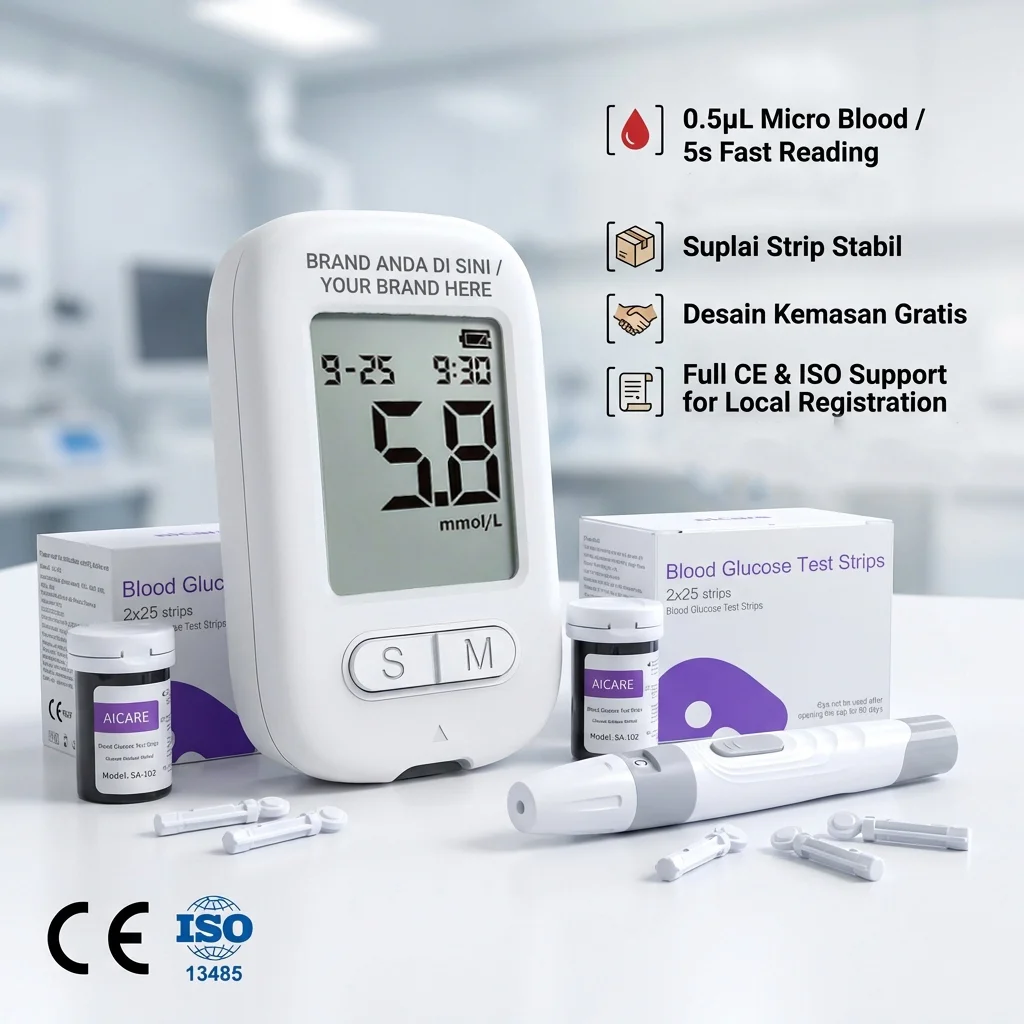
Yesiwell's blood glucose monitor range includes both code-free and coded options, available for wholesale supply or OEM private-label programs. If you are building out a distribution range and want to talk through which format suits your channel and markets, our sales team can walk you through the options — including strip compatibility, batch documentation, and CE certification details.
For more on the economics of strip supply as part of your overall margin structure, see our earlier analysis: The Real Cost of Blood Glucose Monitoring: Strip Supply & B2B Profitability.
Request a product catalogue and sample pricing for your market.
REQUEST GLUCOSE METER CATALOGUE & PRICING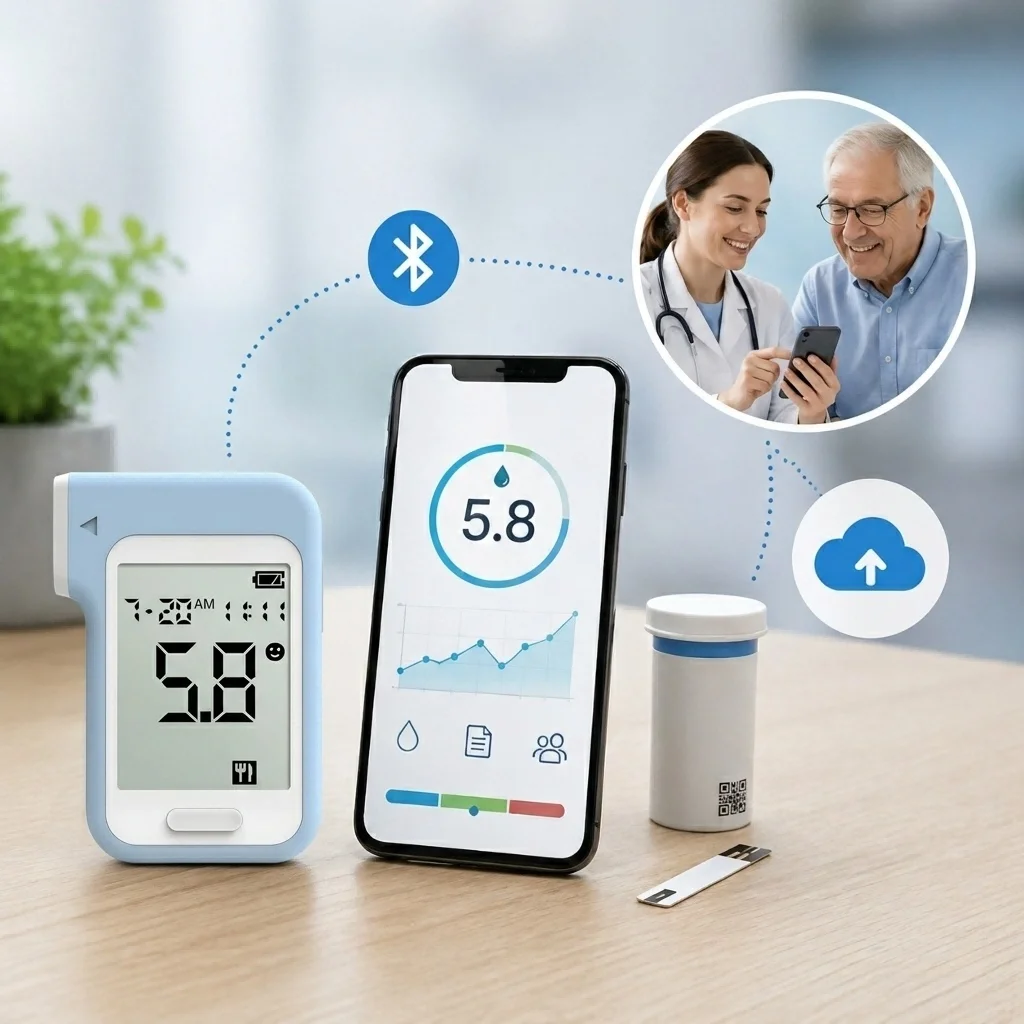
Connected glucose meters carry a higher price and more complex support requirements. Yesiwell's B2B guide helps distributors decide when the smart category is worth adding.
READ MORE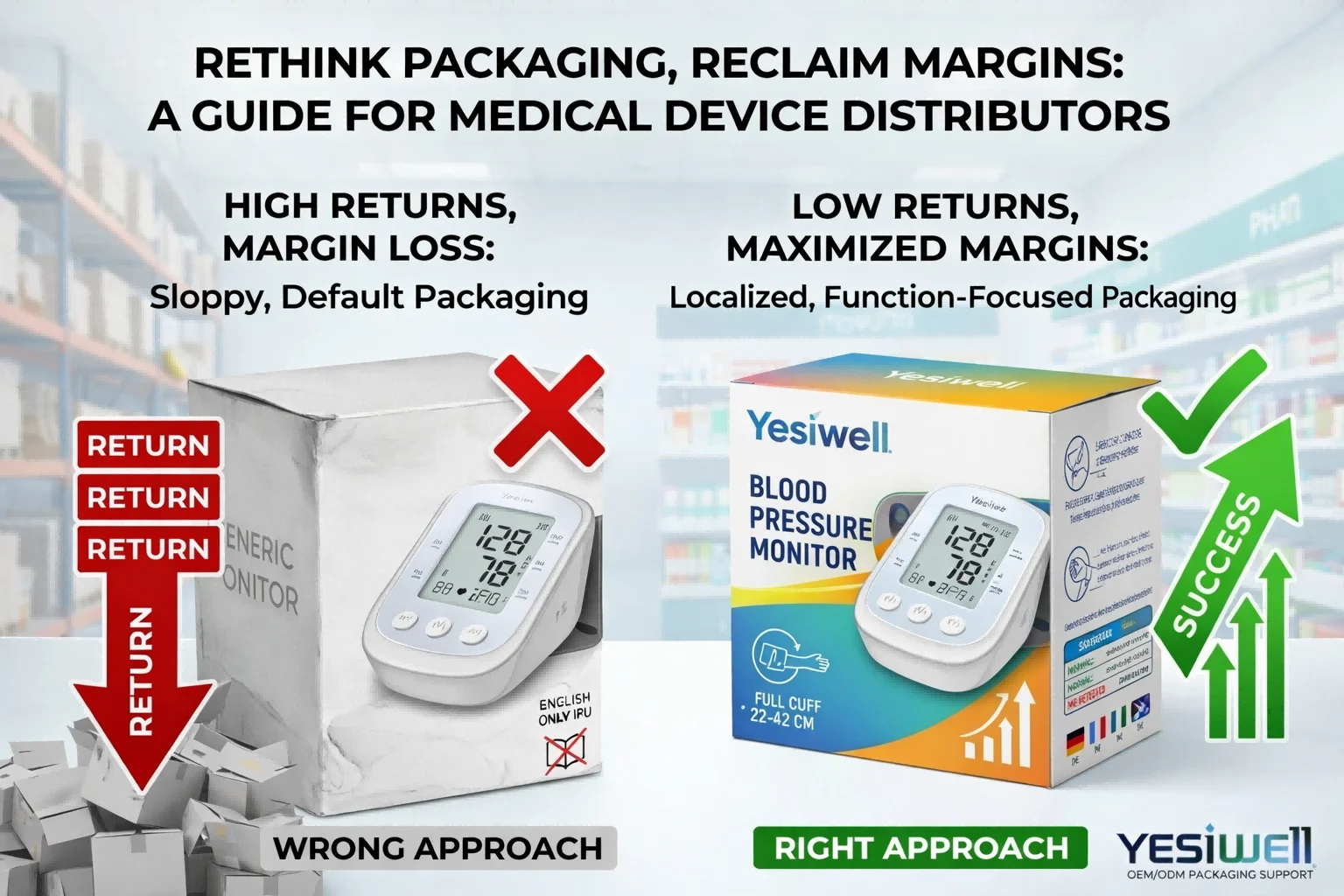
Poor packaging drives returns, compliance failures, and low sell-through. A practical OEM guide for distributors building private-label medical devices.
READ MOREIf you are interested in our products, you can choose to leave your information here, and we will be in touch with you shortly.